
Online Plagiarism Checker vs Manual Checking: What Actually Works in 2026?
Let's be honest — most writers have copy-pasted a sentence at some point and thought, "I'll just rephrase it later." And then forgot. Or maybe you wrote something completely original, but it turned out to sound similar to something else online. Either way, if that content goes live unchecked, it can quietly wreck your search rankings without you ever knowing why.
So the real question is: what's the smartest way to check for plagiarism before you hit publish? Do you need a dedicated tool, or can you just Google a few lines and call it done?
Let's break it down properly.
First — Why Does Plagiarism Even Hurt Your SEO?
Google's job is to show users the most original, useful content it can find. When two pages say essentially the same thing, Google picks one — usually the older or more authoritative source — and pushes the other one down. It's not necessarily a penalty in the traditional sense, but the effect is the same: your page doesn't rank.
Beyond search rankings, duplicate content damages your credibility. If a reader finds your article and then recognises chunks of it from somewhere else, you've lost their trust permanently. And in competitive niches, trust is everything.
This is why checking for plagiarism before publishing isn't optional — it's a basic part of content quality control.
What Manual Plagiarism Checking Actually Looks Like
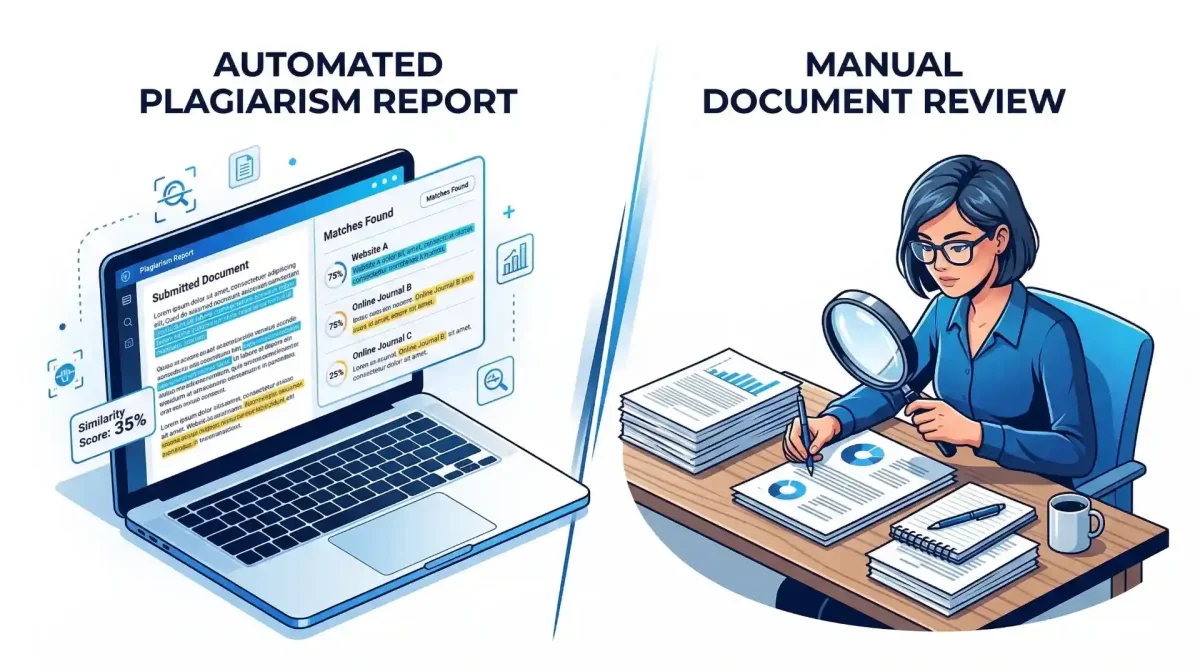
When people talk about "checking manually," they usually mean copying a suspicious sentence, pasting it into Google with quotes around it, and seeing what comes up. If nothing matches, they move on.
It sounds reasonable for a quick check. And honestly, for a single paragraph or a short social media caption, it can be enough.
But here's the problem: a typical blog post has 800 to 1,500 words. That could be 60 to 100 individual sentences. Are you really going to search every single one? Probably not. And the ones you skip are exactly where accidental duplication tends to hide — in the middle sections where you were summarising information you'd just read.
Manual checking also struggles with paraphrased plagiarism. If someone (or something) has reworded a source but kept the same structure and meaning, a Google search won't flag it. You'd have to know the original source existed in the first place.
Where manual checking still has value:
- Reviewing academic citations to make sure sources are properly credited
- Reading through your own draft to catch unintentional phrasing you may have absorbed from research
- Cross-checking a specific paragraph you're unsure about
It's a useful backup — not a primary method.
What an Online Plagiarism Checker Actually Does
An online plagiarism checker doesn't just search Google. It compares your text against massive indexed databases — billions of web pages, academic papers, articles, and previously published documents — simultaneously.
The process works roughly like this: your text gets broken into overlapping segments, each segment gets matched against the database, and anything above a similarity threshold gets flagged. You get a report showing what percentage of your content matches existing sources, and exactly which phrases triggered a match.
The whole thing takes seconds, even for a 2,000-word article.
You can run your content through the Toolszu plagiarism checker before publishing to get a clear similarity report — no guesswork, no manual searching through Google results.
What makes it genuinely better than manual checking:
- It checks your entire document at once, not just the bits you're worried about
- It catches subtle paraphrasing that a search engine won't surface
- It shows you the source of the matching content, so you can fix or cite it properly
- It gives you a concrete similarity percentage, not just a gut feeling
Head-to-Head: The Honest Comparison
Speed Manual checking a 1,000-word article could take 30–45 minutes if done thoroughly. An online tool does it in under 10 seconds. There's no comparison here.
Accuracy A human can miss paraphrased content, similar phrasing, or sources they've never encountered. A plagiarism tool matches against sources you'd never think to check. Online tools win — though human judgement still helps interpret the results.
Coverage You can check maybe 10–20 sources manually if you're diligent. Plagiarism tools check millions. It's not close.
Understanding Context This is where manual checking holds its own. A tool might flag a common phrase like "according to recent studies" as a match — which is obviously not plagiarism. A human can tell the difference instantly. This is why reviewing the report manually (rather than just acting on the percentage score) is always a good idea.
Cost Manual checking costs nothing but time. Many online tools offer free versions that handle everyday blog content without requiring a subscription. For most writers, a free checker covers everything they need.
The Approach That Actually Works
Don't treat this as an either/or decision. The writers who produce consistently clean, original content tend to use both methods — just at different stages.
Before you write: Do your research properly. Don't copy and paste from sources into your draft as a starting point. Keep your notes separate from your writing.
While you write: If you're summarising something you just read, close the source first. Write from memory, then fact-check the details. This simple habit eliminates most accidental plagiarism before it happens.
Before you publish: Run your finished draft through an online plagiarism checker. Look at what it flags, read those sections carefully, and decide whether to rewrite or add a citation.
That last step takes two minutes and removes a huge amount of risk.
Common Questions People Have
Can plagiarism affect a website that's been ranking fine for months? Yes. Google periodically recrawls and re-evaluates content. If a competing page is deemed more original, your rankings can slip even on articles that were performing well.
What similarity percentage is acceptable? Most content professionals aim for under 10–15% similarity. Some overlap is inevitable — common phrases, product names, and factual statements will always match something. What matters is whether the matched content is meaningful or incidental.
Are free plagiarism checkers reliable? For most blog content, yes. Free tools handle standard web-based plagiarism checks well. Paid versions typically offer deeper academic database access, which matters more for research papers than blog posts.
Does AI-generated content count as plagiarism? Not in the traditional sense — AI doesn't copy from a specific source. But AI content can be flagged as unoriginal or low-quality by Google for different reasons. Running it through a plagiarism checker is still a good idea to catch any training data bleed-through.
Final Thoughts
Manual plagiarism checking is better than nothing, but it's unreliable as a standalone process. It's slow, limited in coverage, and easy to shortcut — especially when you're under deadline pressure.
Online plagiarism checkers do the heavy lifting: fast, thorough, and specific about what matched and where. Used properly, they take one of the most time-consuming content quality checks and reduce it to a two-minute step in your publishing workflow.
Use a tool for the scan. Use your own judgement to interpret the results. That combination is what actually keeps your content original, trustworthy, and visible in search.