
Difference Between Word Count & Character Count: A Complete Guide
Table of Contents
- What Is Word Count?
- What Is Character Count?
- Word Count vs. Character Count
- Why the Difference Matters for SEO
- Word Count and Character Count in Social Media
- Word Count and Character Count for Resumes
- How to Check Word and Character Count
- Common Mistakes When Counting Words and Characters
- Frequently Asked Questions
- Conclusion
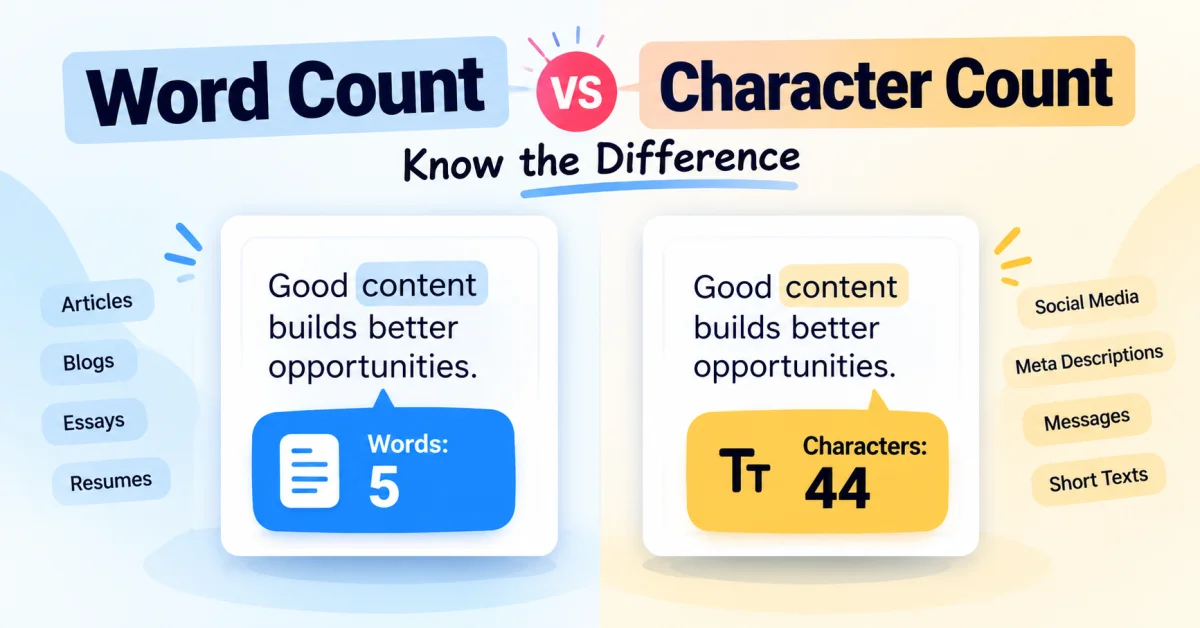
When writing online, two measurements matter more than most people realize: word count and character count. Although they may seem similar, they measure different things and serve different purposes. Word count tells you how many words your content contains, while character count measures every individual character, including letters, numbers, spaces, and punctuation. Understanding the difference can help you write better blog posts, social media captions, resumes, essays, meta descriptions, and other types of content while staying within specific limits.
What Is Word Count?
Word count is the total number of words in a piece of text. A word is generally a group of characters separated by spaces or punctuation.
For example:
“Writing clear content improves communication.”
This sentence contains 5 words.
Word count is especially useful when a platform, client, teacher, or publication gives you a required length. For example, an assignment might require 1,000 words, or a blog post might target 1,500 words.
Why Word Count Matters
Word count helps writers understand the overall length and depth of their content. It is commonly used for:
-
Blog posts and articles
-
Essays and academic assignments
-
Reports and documents
-
Website content
-
Product descriptions
-
Resumes and cover letters
-
Long-form social media content
If you are working with a specific writing requirement, a free word counter can quickly show the number of words in your text without manually counting them.
What Is Character Count?
Character count measures the total number of individual characters in your text. Depending on the tool or platform, this can include letters, numbers, punctuation marks, symbols, and spaces.
Consider this sentence:
“Hello, world!”
Every letter, comma, space, and exclamation mark contributes to the character count.
Character count is particularly important when platforms impose strict limits. A message can contain only a certain number of characters even if its word count is relatively low.
Characters With and Without Spaces
Some character counters provide two separate measurements:
-
Characters including spaces: Counts letters, numbers, punctuation, symbols, and spaces.
-
Characters excluding spaces: Counts the actual characters but ignores spaces.
For example, the sentence “Hello world” contains 11 characters including the space but 10 characters without the space.
This distinction matters when a website specifies a maximum character limit.
Word Count vs. Character Count
The simplest way to understand the difference is to remember:
Word count measures words. Character count measures individual characters.
They are related, but they cannot be used interchangeably.
| Measurement | What It Counts | Common Uses |
|---|---|---|
| Word Count | Words | Articles, essays, reports, resumes |
| Character Count | Letters, numbers, spaces, punctuation, symbols | Social posts, meta descriptions, short messages |
| Characters Without Spaces | Characters excluding spaces | Technical limits and specific writing requirements |
A 100-word article could have significantly different character counts depending on the words used. Longer words naturally contain more characters, while shorter words produce a lower character count.
Why the Difference Matters for SEO
Word and character limits can both affect how you create SEO content.
For a blog post, word count can help you plan content depth, but there is no universal word count that automatically makes a page rank higher. Search engines prioritize useful, relevant, and satisfying content rather than simply rewarding longer articles.
For titles and meta descriptions, however, character length becomes more important because search results have limited display space. Keeping important information concise can help users understand what your page offers before clicking.
Google's Search Central documentation provides guidance on creating content that is useful for search engines and users.
Word Count for Blog Content
Word count is useful when planning a comprehensive article. Instead of adding unnecessary sentences just to reach a target, focus on answering the reader's questions thoroughly.
A well-structured 800-word article can be more valuable than a repetitive 2,000-word article.
Character Count for SEO Elements
Character count is more useful when working with short SEO elements, social media posts, snippets, and other fields with limited space.
Before publishing, check whether your text fits the platform's current requirements rather than relying on an arbitrary character target.
Word Count and Character Count in Social Media
Social media platforms often impose limits based on characters rather than words. This makes character counting particularly useful when writing captions, posts, bios, or short promotional messages.
For example, two captions may contain exactly the same number of words but have very different character counts. A caption filled with long words will use more characters than one made mostly of short words.
This is why checking both measurements can be helpful when preparing content for multiple platforms.
Word Count and Character Count for Resumes
Resumes are another situation where concise writing matters. Recruiters often scan resumes quickly, so unnecessary words can make important information harder to find.
Instead of focusing only on the number of words, consider the space available on the page. Short, action-oriented statements can communicate achievements without taking up unnecessary space.
If you're creating or improving a resume, you can also read our guide to the best free resume builders for practical options and tips.
How to Check Word and Character Count
You do not need to count words or characters manually. An online counter can analyze your text instantly and provide useful information in seconds.
For a more detailed analysis, try the Word Counter Pro tool. It can help you review your text while checking important writing metrics.
A good counter is useful when you need to meet an assignment requirement, stay within a social media limit, prepare website content, or edit a professional document.
Common Mistakes When Counting Words and Characters
One common mistake is assuming that word count and character count are interchangeable. They are not.
Another mistake is ignoring spaces when a platform counts them. Some tools report characters with spaces and without spaces separately, so always check which measurement a particular requirement uses.
It is also a mistake to focus too heavily on hitting an exact number. A target such as 1,000 words should guide your content planning, not encourage unnecessary repetition.
Frequently Asked Questions
Is word count the same as character count?
No. Word count measures the number of words, while character count measures individual characters. One word can contain several characters, so the two numbers will usually be different.
Does character count include spaces?
It depends on the counter. Many tools provide both character counts with spaces and without spaces. Always check which measurement a platform or requirement expects.
Which is more important for SEO: word count or character count?
Neither is universally more important. Useful, relevant content matters most for SEO. Word count can help you plan article depth, while character limits are more relevant to short elements such as titles, descriptions, and social media content.
How can I count words and characters quickly?
Use an online word and character counter. Paste your text into the tool, and it can calculate the measurements automatically instead of requiring manual counting.
Can two texts have the same word count but different character counts?
Yes. Two texts can have the same number of words but very different character counts. A text containing longer words will generally have more characters than one using shorter words.
Conclusion
Word count and character count measure different aspects of your writing. Word count tells you how much text you have, while character count tells you how many individual characters your text contains. Knowing when to use each measurement makes it easier to meet writing requirements, create concise social media content, structure articles, and optimize short-form website copy.
Rather than trying to reach an arbitrary number, focus on clarity, usefulness, and readability. When you need an accurate measurement, an online counter can save time and help you make confident editing decisions.